Showing posts with label Antioxidants. Show all posts

July 20, 2015

When Life Give You Lemons...

By Crabby McSlacker

Yes, it's time for another petulant post! This one is about an evil product I buy sometimes, one that totally pisses me off.


So why is it an incredibly stupid and annoying product?  And if it is indeed an abomination, why am I such a dumbass that I'd buy it in the first place?

June 15, 2015

Antioxidant Supplements: Bad Idea?

By Tiffany Reiss


This is a post by Cranky Fitness contributor Tiffany Reiss, a university professor who, unlike the slothful Crabby McSlacker, actually knows a lot about nutrition and bothers to go beyond the headlines with some actual research and thoughtful analysis. As I've mentioned before, Tiffany is one of the innovators behind the website The Hub Edu, which lets users to build a digital library of resources and share with others.  (In beta but very cool, and free!) More about Tiffany can be found by scrolling down on our info page.  --Crabby

Antioxidants: the pros and the cons: This concept is something that more often than not confuses my students, and at the very least is very eye opening for them.

We have all heard it, read it, been bombarded with it over the past couple of decades. Aging is bad. And what causes aging?  Why it's those little free radicals (or Reactive Oxygen Species (ROS) flying around in our bodies that damage cells and even our DNA that in turn, cause aging and possibly any number of physiological dysfunction (including cancer).

February 03, 2012

Pycnogenol: What the Heck It Is, and Why You May Want to Win Some

Hint: it comes from here.

Yes, this is indeed another review/giveaway post. But I realize it might take a little bit of explaining to get you all pumped up to win a 12 week supply of...

Pine bark pills.

But wait, don't go away!  These are "French Maritime" pine bark capsules! Doesn't that sound a bit more jaunty? Picture 'em sauntering around in sailor suits eating croissants and smoking Gauloises if that makes them sound more intriguing.


Does that help?
(Image swiped from La Maison Boheme)

Actually, there's a fair amount of research that supports a long list of potential health and cosmetic benefits for pine bark supplements. Part of the reason I took on this review/giveaway is that I was greedy to try some free for myself.

So, are you curious about what pycnogenol does, why it's awesome, and how you can win some? (And folks from Canada and Europe are eligible to win too for a change!)


I got a nifty press kit with all kinds of research on the benefits of pycnogenol, and the studies look pretty darn official and persuasive. But the problem? You'd have to come over to my house to read them yourself. I was hoping to link to the research library over at the pycnogneol website, because there's no way in hell I'm retyping a whole thick stack of studies.  But guess what?  It seems to be undergoing construction and making it extremely hard for lazy bloggers to just link over. UPDATE! It's apparently only the U.S. site that's still under construction, and there is tons of lovely pycnogenol research at their international website. Plus there's the stodgy government National Institutes of Health site MedlinePlus, which also has an impressive list of possible pycnogenol health benefits. However, they are a bit more cautious in their endorsement of the stuff.

Or heck, you can skip the actual research and just take a little informative quiz!

1. What is Pycnogenol?

a) A super antioxidant, natural anti-inflammatory which selectively binds to collagen and elastin and aids in the production of endothelial nitric oxide which helps to vasodilate blood vessels;

b) A potent recreational drug which will cause you to see purple iguanas crawling out of people's ears;

c) A placebo made of powdered Kool-Aid and pine scented air-freshener as an elaborate prank to fool greedy unsuspecting health bloggers; or

d) A large anal suppository noted for its ability to raise your speaking and singing voice 3 octaves higher.

2. Which one of the following health or cosmetic benefits is Pycnogenol supplementation NOT associated with in at least some study or other?

a) Asthma and allergy relief;
b) Increasing skin elasticity, smoothness and wrinkle reduction;
c) Lowering blood pressure;
d) Improvements in cardiovascular health;
e) Reducing symptoms of osteoarthritis;
f) Improved cognitive function;
g) Reducing pelvic pain and menstrual disorders;
h) Fighting diabetes;
i) Lowering inflammation;
j) Reducing tinnitus (ringing in the ears);
k) Fighting varicose veins;
l) Increasing athletic endurance;
m) Enabling time travel up to 500 years forwards or backwards;
n) Reducing circulation problems like leg pain and fluid retention;
o) Treating retinal disease;
p) Improving joint health.

3. Possible Side Effects of Pycnogenol May Include:

a) the sudden appearance of extra toes or fingers;
b) a boost to the immune system, which can be problematic for auto-immune disorders; dizziness; gut problems; headache; and mouth ulcers;
c)  a French accent;
d)  invisibility.

Answers: 1: a; 2: m; and 3: b... but you knew that!

What Did Crabby Notice Most From Trying Pycnogenol for 12 weeks?

It was actually first pitched as a way to "maintain beautiful skin from the inside out." Which sort of assumes you have beautiful skin to maintain in the first place. Sadly, after 5 decades of playing out in the sun, that's not what I'm starting with. Can't say I noticed a huge difference, but maybe a bit more color? I will spare you before and after photos, mostly because I forgot to take any.

However, during the testing period I found it noticeably easier and easier to extend the duration of my cardio workouts, even at a challenging intensity! The whole "increasing athletic endurance" was definitely true in my case. Was it due to the pycnogenol or some other aspect of my ever-changing routine? I have to confess I was not the least scientific about my personal experimentation. During the same period I also switched up my method of HIIT, started eating nutritional yeast, discovered mushroom powder, and had a bikini wax. So it remains unclear the exact cause of my newfound ability to dance around like an absolute ass on the elliptical machine for twice as long. But I'm superstitious enough not to want to abandon the pycnogenol at this point.

And reading the research, there were so many potential health benefits to this stuff and no side effects that were relevant to me, so it seemed a reasonable thing to keep taking just on general principle. Plus it's not outrageously expensive or anything.

So, would you like to win some stuff that might get you glowy skin, super-endurance, relief from a bunch of nagging health problems? Just leave a comment below! I'll announce the random winner in a week. Be sure to check back before the end of the day Wednesday Feb 15th to claim your prize or a new random drawing will be held.


Do you guys have any favorite supplements? Or do you try to get everything you need from your healthy diet?


May 13, 2009

Weird Study: Antioxidant Vitamins Mess With Exercise?


This is just quick research note without even an attempt at any humor.

But don't worry, there is also a "100% research-free" item just below, with no useful information in it at all!

So for your recommended daily allowance of Cranky Fitness silliness, simply take both these together with a large glass of water, and you should get all the benefits of a "normal" post! Warning: do not attempt to drive your car or operate heavy machinery while under the influence of Cranky Fitness. May cause extreme drowsiness, skepticism, stomach irritation, and/or high blood pressure.

Anyway, so did anyone see the WTF headline in the New York Times health section yesterday: Vitamins Found to Curb Exercise Benefits?


More specifically, taking antioxidants (in this case vitamins C and E) seemed to interfere with the benefits you get from exercise. These pills apparently eliminate the improved insulin sensitivity you're supposed to get from doing the huffy-puff stuffy. And the supplements also seemed to mess with the body’s natural defenses to oxidative damage.

“If you exercise to promote health, you shouldn’t take large amounts of antioxidants,” one of the study's authors, Michael Ristow, said. The effect of vitamins on exercise and glucose metabolism “is really quite significant.”

Fortunately, the study author said this is just the case with antioxidant supplements, and does not mean you have to choose between your cauliflower and your cardio. You can still get antioxidants from fruits and vegetables because "the many other substances they contain presumably outweigh any negative effect."

A write-up of the vitamin and exercise study over at WebMd offers a bit more helpful detail: half of the men took 500 milligrams of vitamin C twice daily and 400 international units of vitamin E daily. The other guys got placebo pills.

Of course a spokesman for the supplement industry cautioned that one shouldn't take any one study too seriously!

Which is true, but also kinda funny, because they never seem to emphasize that point when it's a study saying that some supplement does some fantastic thing for your health.

While I don't take specific C or E supplements, this does make me wonder about my daily low-dose, cover-all-the-bases multi-vitamin. I still haven't decided what to do. Give it up? Just take it less often? Wait for another study to clarify if this effect is even real?

What about you folks, would this study result change anything you're doing or have you already ditched the pills?

February 02, 2009

Berry Good News


Remember how last week I was bummed because a new study said cooked broccoli delivers only one tenth the awesome antioxidant goodness that raw broccoli does? And I was all mopey because I hate raw broccoli?

Well, the Nutrition Gods must have heard my whining and felt sorry for me, because shortly thereafter they sent me new research saying: stuff I'm already eating is good for me in ways I didn't know about! Hooray! That's my very favorite kind of research.


So what was the good news about berries?


Whoops! Broccoli Digression

But wait--before I get to the berries, here's an update on the raw broccoli situation. As it happened, there was a happy ending.

Those of you who read the blog regularly know that I am Certified Crackpot when it comes to antioxidants and other micronutrients. I harbor the delusion that if I eat a large variety of these things I will never, ever die. So after hearing that the kind of broccoli I liked was lame and would not make me live forever, I was distraught.

But help arrived!

In the comment section to the raw broccoli post, DragonMama (who also goes by Naomi) suggested that I try "broccoli slaw." I hadn't even heard of it, but sure enough, I went to the "we're going to charge you up the wazoo 'cause it's already washed and chopped" section of the produce department, and there was a big 'ol bag of the stuff.

I confess I was skeptical. Broccoli slaw is presumably made from broccoli. How could it not taste vile?

But it doesn't!

Sure, it took a little dressing to make it tasty (which could have theoretically been a healthy home-made dressing with no sugar and only good fats; let's just pretend it was, shall we?) Anyway, I mixed a little dressing in and it worked! Now if I can remember to keep a package of this stuff handy, I can live to be 1,000 without having to choke down any nasty little raw broccoli florets. Thanks, Dragonmama!

All right, that's enough about the damn broccoli.


Berries Don't Have to Be Blue


So we already know berries are good for us in general sorts of ways, but it's always nice to hear the specifics. And the New York Times has great things to say recently about berries as cancer-fighters.

Now I always thought blueberries were supposed to be cancer-fighters, but it turns out while they may be awesome for your memory, other berries are more potent cancer-fighters. In particular, black raspberries seem to be where it's at. And the kinds of cancers they seem good at preventing are oral, esophageal and colon cancers.

One problem: what the hell is a black raspberry? I like raspberries; I like blackberries; I'm guessing I'd like a black raspberries too but I can't say I've ever met one. There's nothing like reading a study that says: oh you must eat this wonderful fruit that is so good for you and isn't available anywhere you shop!

However, there are other berries that scientists seem to think are promising in the anti-cancer department, like red raspberries, blackberries, strawberries, and elderberries. And it appears from rat studies that "a concentrated powder of black raspberry anthocyanins" worked just as well for slowing tumor growth in rodents as the real berries did. Rats who got whole berries or anthocyanin powder developed 50 percent fewer esophageal tumors compared to untreated rats.

The article conceded that berries can be expensive. It's rare that an article in the New York Times ever goes to the grocery store and finds out the price of things it tells you to eat, so kudos to this one for admitting that berries are pricey. Oh, and apparently you also need to eat a hundred thousand tons a pound of berries a day to get as much as the rats did in the study.

However, a cheerful cancer prevention researcher named Gary D. Stoner, (and I won't make fun of his name, that would be so immature),
(Ok, so I lied)

suggested buying frozen berries, because they are available year round and often are cheaper than fresh berries. Which is great, because as it happens, frozen berries are a key ingredient in Crabby McSlacker's Easiest Smoothie Recipe ever! Also, for you supplement-buying sorts (I rarely go this route, because I'm cheap) there are apparently concentrated berry powders available in health food stores.

"We think for the average American, probably the consumption of three to four helpings of berries every week is a good thing," said Stoner. "We know berries have so many effects on processes related to cancer development. They are one of the food stuffs you probably should consider consuming every day, or at least a few times a week."

And unlike raw broccoli, berries of any color actually taste good!

Don't have any strong feelings about broccoli slaw or berries? Well, how was your weekend? Did you watch the Superbowl?

January 23, 2009

Raw Broccoli: Crabby Draws the Line

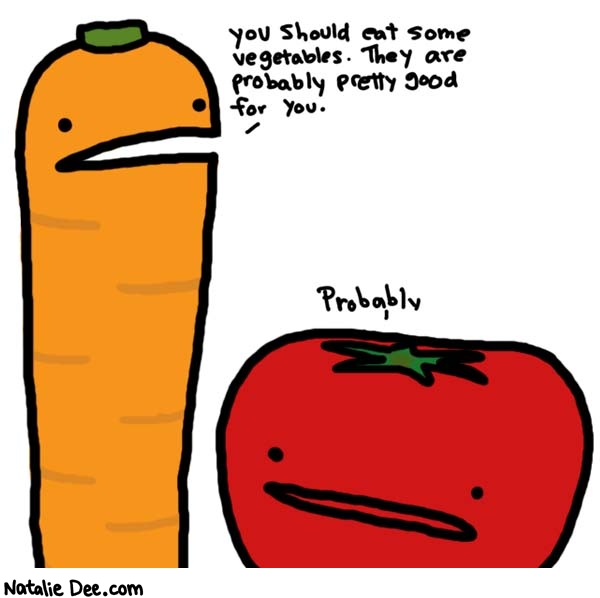
Cartoon by Natalie Dee


I may have mentioned before that I'm one of those crackpots who will often heed the results of the health studies I read.

For example, years ago I read that red bell peppers have more nutrients than green ones, and blue potatoes have more than white ones. So I will actually go out of my way to buy blue potatoes and red bell peppers.

I know full well that often these studies are followed up by newer studies that say the opposite. But when I'm not tearing my hair out cursing all the conflicting studies, I tend to remember the last thing I read, and if possible, I do what it says.

On the other hand, sometimes when I don't like the results, I pretend I never even read the study.

Like when I read that you shouldn't put milk in your tea or you won't get any of the antioxidant benefits. I tried tea without milk, didn't like it, and so I said "Feh! I'll drink it the way I like it!" (Actually, I'm guessing I used a different word than "feh," but I bet it also started with an "f".) And while the jury is still out on the whole issue, at least one tea with milk study came along and said--nah, it's ok--go ahead and add milk if you like.


So what's the latest study I plan to ignore?


One that says raw broccoli delivers ten times more of the anti-carcinogen sulforaphane than cooked broccoli.

Which is great news for all you folks who like it raw!

But I hate raw broccoli and don't mind it cooked. More specifically, I like it best if it's overcooked, and combined with other tasty ingredients like olive oil or garlic or cheese.

(And yes, there was indeed an earlier study that said the opposite: that cooking broccoli increased antioxidants. But alas, there's a difference between how much of the good stuff is in the food, and how much actually ends up in your bloodstream, so that's part of the reason the studies go back and forth. Am I ridiculously obsessed with stupid unpredictable antioxidants that keep changing their minds? Yep, apparently so!)

Anyway, as much as I like the idea of all that virtuous sulforaphane being ready and available in raw broccoli, I'm still going to cook the hell out of it. Of course, I could just eat TEN TIMES AS MUCH broccoli as I used to in order to make up for the fact that I cook it, but I think I'd rather say "screw it" and croak a decade or so earlier.

Oh wait. Wasn't I just saying the other day about how I'm feeling all inspired to be more positive on the blog from now on, and not quite so Cranky?

Whoops!

Well, um...

Hang on, I'm thinking...

Got it!!

(If this blog had a soundtrack, harp music would now be playing...)

Broccoli may have been the vegetable they studied, but it isn't the only one that has sulforaphane in it, right? There's cabbage and cauliflower and some other ones too. I bet they're also pretty powerful cancer fighters if eaten raw.

Raw cabbage... that's coleslaw! And raw cauliflower.... that's not so bad! Especially if you dip it in something yummy. (At the moment, let's ignore the fact that most yummy dips are full of saturated fats or the wrong omega's or whatever.)

So until the scientists change their minds again, I'll skip the raw broccoli, but please pass the raw cauliflower and dip. And I'll take a side order of coleslaw!

(Anyone placing bets on how long this whole "have a more positive attitude" thing is gonna last?)


Does anyone else read about health research only to ignore the findings they don't like? Anything in particular you're ignoring at the moment?

December 08, 2008

Aging, Antioxidants, and Annoyance


This is just a quick grumpy post about a recent study on antioxidants and aging I read.

Why so quick and grumpy?

Because I didn't like the results, damnit!

Hey, You Promised If I Ate All Those Antioxidants I'd Be Young Forever!


I hate it when a study comes along and dashes my hopes for eternal life. Yes, I know no one has guaranteed that the right combination of nutrition and exercise will keep me young forever. (And a quick glance in the mirror reveals there's definitely a flaw in this theory).


However, it's been kind of implied that if I down enough blueberries and red wine and broccoli and dark chocolate, etc, that all those antioxidants would fight off the nasty free radicals that would otherwise cause me to age faster. I will feel thirty or forty-ish, I was hoping, until I'm actually ninety-ish.

Perfectly Good Aging Theory Spoiled by Worms


Blame Denham Harman for my false hopes. It was his theory that said that aging is due to "an accumulation of molecular damage "caused by "oxidative stress." This theory has apparently been popular for over fifty years, so I had a good excuse for believing it and scarfing up all the antioxidants I could.

But alas, it turns out that a guy named David Gems and some stupid worms are trying to ruin my plans to never grow old.

In this new study, Gems and his colleagues fiddled around with a bunch of nematode worms and beefed up their ability to "mop up" surplus superoxide and limit oxidative damage. Unfortunately, "the lifespan of the worm was relatively unaffected by its ability to tackle the surplus superoxide." This casts serious doubt on the theory that antioxidants will make you live longer. Gems thinks "other factors, such as chemical reactions involving sugars in our body, clearly play a role."

Crap.

Since this kind of research is far beyond my ability to understand or critique, I'll just have to hope more studies come out and contradict it.

Or, even better, I hope that they figure out a new key to staying young, and that it involves a daily regimen of watching HBO and Showtime series on DVD, eating cupcakes and cheeseburgers, drinking margaritas, and sitting in a massage chair to relieve stress. C'mon scientists, get crackin'!

You Still Have to Eat Your Fruit and Vegetables


Just because antioxidants may not halt aging itself, they are still potent disease fighters so you're not off the hook. Gems concluded: "a healthy, balanced diet is very important for reducing the risk of developing many diseases associated with old age, such as cancer, diabetes and osteoporosis. But there is no clear evidence that dietary antioxidants can slow or prevent aging. There is even less evidence to support the claims of most anti-aging products."

Darn it. Guess I'll go eat worms.

Anyone else disappointed that there might not be a dietary "magic bullet" to prevent aging? Got any good anti-aging suggestions, or are you perfectly happy to grow old gracefully?

August 27, 2008

Diet and Cancer


[Special Guest Post by Christine Hanley]

Note: this is a 3-part post by Christine of Póg Mo Thóin Slán Leat. You may want to bookmark it, because it is one of the best explanations I've ever seen as to why eating healthy can reduce your cancer risk. It's very informative and motivating, not to mention amusing, which is hard to pull of when writing about cancer. Thanks Christine!--Crabby]


What is Cancer?

One way to understand Cancer is to think of your body as a nice, posh, invite-only wine and cheese ‘do at your house. When the party (your body) is functioning properly, the number and quality of party attendees (cells) is regulated. If someone turns out to be an inappropriate guest (a cell damaged beyond repair), you ask them to leave and everything is back to normal (this is your body’s natural process of cell death, aka apoptosis).

However, let’s say something has caused you to be incapacitated for some reason (your body’s natural cell death system is not functioning properly). A real jerk shows up to your party and starts off by chugging a bottle of wine, messing with the stereo and annoying your guests, but you can’t get out there to get rid of him. Then he gets on the phone and starts inviting all his jerky friends over (the bad cell, having not gone through natural cell death, begins to replicate). The jerks start taking over for real now, since all of them are phoning their jerky friends over (all the cells are replicating uncontrollably) and they’re starting to get into areas that the party was not even supposed to be in, crowding out the nice guests you invited (regular, healthy neighbouring cells) and oh look, now there’s a disgustingly raunchy threesome with all sorts of questionably legal acts happening in your marriage bed. Like, I'm talking, one of the participants is a goat. Cancer is nasty business folks, and it’s got no respect for anyone or anything.

Now, hopefully by this stage, someone will have called the cops (you’ll have noticed something has gone wrong and gotten yourself to the doctor). Because, if this situation goes completely unchecked, some of these drunkards will get into their cars and start driving down the roads and invading other parties in town (new parts of your body) and the whole thing will start there as well. This is metastasis, where pieces of the Cancer break off and go to completely new places and grows new tumors.

So in short, Cancer is caused by your cell security system (cell death) breaking down and causing damaged cells to replicate uncontrollably, invading other tissues and possibly metastising via the blood and lymph systems into new parts of the body.


Cancer Prevention

Since Cancer is basically a bunch of bad cells dividing uncontrollably without anything to tell them to take a hike, we can infer that Cancer is therefore best avoided by preventing the loss of your cell security system. This cell security system is hard coded into your genetic code, aka your DNA. All Cancers are caused by DNA anomalies: mutations.

Mutations can be caused by any number of things; you can be born with them (Genetics), or you can acquire them, through plain old DNA replication errors, (when your cells divide normally, each cell gets a new copy of DNA made especially for it, and sometimes it’s copied wrong like a badly executed Xerox) or through something physically interfering with the DNA molecule. This last cause, physical interference, is where diet comes in to play. I’ll talk about two major types of physical interference: intercalation and oxidization.

Something to remember, however, is that you have a LOT of security. In fact, your DNA’s security systems definitely outstrip that of even a post 9/11 airport. So you need a LOT to go wrong before you get Cancer. Clearly, though, it does happen.

Intercalation

Certain types of nefarious molecules can sort of slide into your DNA like an issue of Penthouse into a Harvard Library bookshelf. High falutin’ scientists call this “intercalation”. Basically, it means that your DNA is like a big huge stack of plates. Every plate is the exact same size and type so there’s no problem stacking them so high and it’s quite stable. Intercalation is like sliding a mismatched plate into the middle of the DNA molecule. This throws off the whole stack, and can screw up all loads of things. If it screws up a part of your DNA responsible for the cell security system, you can get a runaway cell that causes Cancer.

Molecules that cause intercalation are, by and large, “flat” molecules. They’re often kind of disc shaped, usually. Polycyclic Aromatic Hydrocarbons (PAHs) are one of these: you can tell by the name: “cyclic”. Like a circle. Disc shaped. They are formed when fat is burned over high heat – so when you barbeque a steak. Another is Acrylamide, which is formed when you brown starchy foods – like when you toast a slice of bread or fry a potato.

However, the body does do a wonderful job of policing the molecules that get into it: people have a family of enzymes called Cytochrome P450s that alter alien molecules so that they don’t fit into DNA, and making them water soluble so that your body flushes them out with the rest of your wee. This is why it’s ok to eat toast and steak in moderation: because as long as you don’t give your body a deluge of these toxic compounds, your body can handle them just fine, it’s got built in defences against most of what you can throw at it as long as you’re generally treating it right.

Oxidation

The second process I’ll talk about which alters your DNA and therefore can cause Cancer is called oxidization. This is a process in which your DNA gets damaged, (oxidation is the same process that's rusting your car right now). Again, if the cell security system takes a hit… I’m pretty sure you’ve figured out by now what that means.

When you digest food, you are essentially breaking chemical bonds. Sometimes the breaking of a chemical bond creates something called a Free Radical, which is missing an electron, which will sometimes search out a stable molecule from which to steal an electron. This is considered to be a major factor in DNA damage, which not only causes Cancer, but aging in general as well.

Here is where that all powerful anti-oxidant comes in: they neutralize the Free Radicals before they can damage your DNA. Anti-oxidants are bodyguards for your DNA. To prevent Cancer, you want to make sure you have enough anti-oxidants to neutralize any Free Radicals that might occur. There is NO such thing as too many anti-oxidants.


The Cancer Most Linked to Diet


By and large, the number one Cancer that you can prevent through diet is Colorectal Cancer. It is the third most common Cancer in both men and women in the US, so it’s certainly worth pausing to think about. People don’t like to talk about it though, since it’s fundamentally Ass Cancer.

I’m sure I don’t need to tell you that a large risk factor for the development of Colorectal Cancer is a diet high in fat and low in fibre – which is essentially the Western diet. Researchers figured this out when they found that people from Swaziland have nearly NO Colon Cancer, which they thought might be due to the fact that the Swazilanders eat hugely fibrous Betel Nuts which make them take about 3 or 4 dumps a day. Freakin’ impressive, man. (They then did a lot of fun studies on Intestinal Transit Times involving timing how long coloured pellets took to “emerge”. Interestingly, English boarding schools were the most anal retentive. I totally wish I had a source for that one besides my University Chemistry professor.)

Anyway, since then there have been a lot of studies corroborating the fibre/colon Cancer protection link. There are a number of theories as to why this occurs, the two most popular being that fibre increases fecal bulk, thus diluting Cancer causing compounds in the intestines; as well as decreasing the amount of time the crap (literally) hangs around in your colon, thus limiting your intestines' exposure to the toxins within.

Take Home Messages


  • Your body is well equipped to deal with all sorts of intruders, as long as you don’t launch a full on dietary blitzkrieg on it. Eat foods with known carcinogens (such as BBQed meats) in moderation and your body will dispatch them quite efficiently.
  • Make sure you eat plenty of anti-oxidant containing foods (by and large these are your fruits and veggies) to provide your DNA with plenty of protection from the wear and tear of daily life.
  • Lastly, eat whole foods high in fibre: they’re your best defence against Colorectal Cancer, by getting the toxins in your poo out of your body ASAP.

Christine Hanley isn't a dietician or a doctor or anyone with any fancy shmancy right to tell you what to eat, but she did study Biology for four years at McGill University and ended up with a BSc. Which has proved to be totally useless so far, but hey, she's not bitter. She usually blogs at Póg Mo Thóin Slán Leat.

April 30, 2008

Your Brain on Blueberries


[By Crabby]

So yet another study has come out saying that blueberries and other phytochemical-rich foods are good for your brain. These superfoods are even supposed to be "effective at reversing age-related deficits in memory."

Hooray! I love hearing that the healthy food I make myself eat all the time is really good for me.

But hey... wait JUST one minute.

I eat tons of blueberries and consume boatloads of other phytochemicals. And I exercise and get Omega 3's and do all that good brain stuff. And how good is my memory?

It's crap!

Well, it's not Alzheimer's time yet, but since I hit my mid-forties, I've definitely noticed an ever-increasing tendency to space things out.


Someone Never Forgets, but it Sure Ain't Crabby


Would it be that much worse if I was subsisting on the average American Big Mac and Coke and Twinkie diet? Would I enter and leave and re-enter and re-leave and re-re-enter and re-re-leave a room ten times, instead of five, before I finally recalled what I the heck I was looking for?

(Note: Apologies to you young folks. This post will seem boring and irrelevant. Check back in a few years when you, too, are wandering all around the house trying to recall where you set down your coffee cup only to discover you're actually still carrying the cup in your hand.)

Growing up, I'd heard that people's memories started to decline as they got older. But I thought they meant older older. Like, 80. I had no idea that stuff started slipping so soon.

Of course, if I'd just admit my memory is starting to go down the toilet, then perhaps I'd develop better coping skills. I'd write lists and learn mnemonics and rehearse things and just generally pay more attention. But instead, I just float around like I'm still 20 and don't really try to remember things. I just assume that important information, once heard, will be recalled.

But sometimes, it isn't recalled. It's just gone-- phhht!

It's not just the important stuff, either. It's all kinds of things you used to know. Have you ever sat with a group of middle aged people watching Jeopardy? You could make a whole new game out of it. Every time someone says something like: "I know that! Damn it, I know I know that!"--you all have to eat a handful of blueberries.

But here's the one that bothers me the most: often, I will think I have forgotten to do something. So, for example, I'll drag my sleepy ass out of bed and stumble downstairs at 3 a.m. because I suddenly realize I didn't remember to feed the cat or lock the door or whatever.

But of course I once I'm down there, I discover I did remember to lock the door and feed the cat--I just have no memory of having done it.

Perhaps there are only so many slots for mundane day-to-day memories, and by your mid-forties, most of these are full. I'm sure if I went to feed the cat one evening and discovered she was standing on her hind legs and had sprouted opposable thumbs and was using the can opener to help herself to our tuna supply--well, I'd remember that.

I hope.

(There are some memory resources here and a lot of products and services out there you can purchase which can help to train your memory. Personally, rather than add yet another set of exercises to my to-do list, I'd rather just forget things and whine about it. Other tips I've seen: get more sleep, magnesium, fish oil, choline, exercise, relaxation, social activity, and sage.)

Is anyone else a bit forgetful sometimes? Any suggestions?

April 16, 2008

Stay young and win money, bicycles & stuff


[By Merry]
I have a confession to make – I buy Lipton brand black tea. On purpose. People make fun of me, because this is not a brand of tea that claims to have been hand-picked by Tibetan monks who’ve intermittently fasted for weeks before the tea harvest. But I’ve been drinking it for years because it helps with my migraines.

Migraines are bad. Trust me. When I get migraines, I develop an extreme sensitivity not just to light but also to smells. Hyper-sensitive to smells. Really, really hyper-sensitive. I can't stand the faintest smells. Migraines have something to do with dilated blood vessels, and black tea helps alleviate that condition. So if I have a migraine, I end up drinking lots of black tea.

When I’m in migraine-mode, I don’t want any damn fancy tea with oil of bergamot or some hint of lavender – that drives me crazy. I can't stand those smells, it’s the nasal equivalent of nails on a chalkboard. Nor do I want something that’s so strong it’s going to hurt my stomach (like most of the expensive brands of black tea) or something so weak it’s not going to do any good (like most of the generic brands of black tea). I like the Lipton brand because it delivers tea with a consistent amount of strength and quality, and because it doesn’t have a lot of frou-frou extras. And because I think it helps with the headaches.

So when I was approached to do a contest advocating Lipton white tea, I was all for it. Your mileage may vary, and I suspect Crabby might be humoring me. (I mean, have you read the things Crabby does to her tea?)

What did they do, offer you lots of goodies?

They offered me some free tea, which I’m going to try out. Sadly, no diamonds, rubies, or pearls were included in the offer. On the other hand, white tea (unlike jewels) delivers loads of antioxidants, which are a lot healthier for you if not so sparkly.

You’re just going to become a huckster and pitch products to people? How boring!

No, I’m also going to mention that you can win a free bicycle, money, and stuff.

Oh. Well, that’s okay then.

The Lipton people are very kindly sponsoring a contest. Since Lipton’s White Teas are made from young tea buds, plucked early in their life cycle, they're going for a "Free your Y" contest. It's about freeing your youth and drinking white tea. Look, if you want pertinent details, check out the link: The Free Your Y Video Contest.

I like the idea of drinking white tea, because it's got more antioxidants than Albert Einstein had brain cells (or at least a comparable number), and because I like the idea of being young much better than being old. Or at least the idea of feeling young, i.e. feeling healthy. The idea of freeing my inner youth sounds pretty good to me.

Besides, you’re not old, are you? I don’t care if you’re sitting in a rocking chair waiting for meals-on-wheels to stop by, you’re not old inside, no matter what your body may look like on the outside. The person inside doesn’t age. Why not show the world that you’re not old?

Why the hell drink white tea? What’s the difference?

All true teas are made from the same plant, Camellia sinensis. Black tea is heavily fermented, while green tea is moderately fermented, and white tea lightly fermented. The more fermentation, the more antioxidants are destroyed. (You still get some, just not as many.) White tea has the highest antioxidant levels of any true tea you can find. (I’m not talking about herb teas such as Red, or Rooibush, tea. Including them in this paragraph would make life far too complicated and probably bring on a headache for both of us.)

Wait a minute. Go back to the chance to win money and stuff.

Very simple. All you need to do is:

1 – Think up some way to show you’re young. To quote from the Free Your Y site:
MOVE & GROOVE:
Cut loose. Make it old school, original, or freestyle–whatever moves you. Use any of the music tracks we've supplied here, or your own originals. Please, no copyrighted tunes.

TRICKS AND FEATS:
Show us your skills, like a reverse dunk or a Triple Lindy. Let's see your best trick shot or athletic move.

FREE FOR ALL:
Here's your chance to showcase your unique talent–stupid human tricks, silly songs or watermelon juggling–whatever doesn't fit into the other categories. Anything goes!

2 – Videotape it. Do you have a digital camera or cell phone that tapes very short videos? Or do you have a friend or relative who does? There you go.

3 – Send it in to these people. Why?
• The grand prize winner will receive $25,000
• One second place winner will receive $10,000
• One third place winner will receive $5,000

What the hell, why not?

What about the free bicycle?

Oh, you want more details about the bicycle contest on Cranky Fitness.

Details about the bicycle itself

1 - There's a picture of it shown up top. More information here.
2 - It's free if you win the Cranky Fitness contest.
3 - In addition to the bike, the winner will receive 5 coupons for Free 1.5L of Lipton White Tea and a $75 check for professional assembly of the bike.

Details about the contest

In keeping with the high standards here at Cranky Fitness, we decided you needed to work for this bike. Here's what you have to do:

1 - Figure out what you would recommend people do to stay young and active.
2 - Post your recommendation in the Comments section below. (I was going to say, email it to us, but Crabby has a very hungry spam filter, and this way your comment won't get eaten.)

It’s not enough to merely stay alive. I want quality years! I personally want to die of extreme old age on a yacht, with a champagne glass in my hand and a cabana boy massaging my feet, whilst watching a magnificent sunset -- not counting my wrinkles and thinking of all the things my body used to be able to do once upon a time. Any recommendations you have will help! That way everyone who reads the post will get useful tips on how to stay young and active.

Crabby and I will number the comments in the order received, and pick a number based on a random number generator.

Deadline: winning entry will be picked Friday, April 25.


Obligatory disclaimer
The Pepsi/Lipton Partnership will provide a check for $75.00 to be used for professional assembly of all Lipton Fuji bicycles awarded. Neither Pepsi Co. nor Unilever is liable for any injuries, damages or accidents that may result from the receipt, assembly or use of this bicycle.

December 10, 2007

Annual Pomegranate

Looking All Wholesome And Innocent...

On a recent trip to the farmer's market Crabby came home with a pomegranate. She ate it in two sittings: once by itself (yumm), and once accompanied by a kiwi (even yummier). Note: we're talking the fruit kind of kiwi; Crabby did not pick up a New Zealander at the farmer's market, even though they do have cute accents and the Lobster happens to out of town. Crabby is not that sort of Crab.

Anyway, the kiwi/pomegranate combination is awesome. Both fruits are sweet and tart in the same kind of way, and the colors look so pretty together. The visual effect is so impressive you may want to take a picture of your little fruit bowl and post it on your blog! But that would mean hunting down your camera and the battery's probably not charged and you're too hungry so whatever. Forget the picture.

Kiwis and Pomegranates are both high in antioxidants. And though research is somewhat preliminary and mostly animal-based, pomegranates are suspected to ward off all kinds of diseases, like prostate cancer and heart disease and diabetes and such.

So why is that probably the last pomegranate that Crabby will consume until next year when she is again tempted?

Because if you commissioned a battalion of engineers to try to design a more sneaky inaccessible fruit they'd be hard-pressed to beat the pomegranate.

The outside is all hard and leathery, so you dig your thumbs in to peel it. Squirt.

The inside is all stuck together and you have to try to pull the little sections. Squirt.

The sections are covered with a thin membrane that tastes terrible and that seems to start coming off but then gets stuck--sort of like when you're peeling a hard boiled egg. You're so close, yet the membrane keeps breaking so you dig little more frantically and... Squirt.

And note: All this Squirting would not be a big deal if this were a lemon or a cantaloupe, but pomegranate juice is dark reddish and it stains!

By the time you're ten minutes into and spattered with juice stains, it's is easy to declare, NO MORE POMEGRANATES EVER, OR AT LEAST NOT FOR A VERY LONG TIME!

(You can buy the juice instead, which may actually be more nutritious anyway--but Crabby detects a yucky musky flavor in the juice which she doesn't in the fruit, so she's learned to ignore those cute little overpriced bottles of pomegranate juice at the store).

So here's one way to deal with opening up a pomegranate.

But Crabby has her own instructions.

1. Take pomegranate in left hand, sharp kitchen knife in right.

2. Rethink; put both down.

3. Take off all your clothes.

4. Take pomegranate in left hand again, sharp kitchen knife in right, and retreat to bathtub.

5. Decide knife is superfluous and set it down nearby.

6. Dig in rip open pomegranate with fingers, greedily biting any exposed sections and covering most of self in dark red juice.

7. Try to calm spouse down when you are discovered in tub with kitchen knife at your side, covered in dark red fluid.

8. Resolve to buy pomegranate juice next time even if you don't like it as much.

Winter fruit is a hard subject to comment on--so Crabby will not be offended if you stray onto other subjects or even other blogs. Just come back eventually, or she will be very sad!

November 29, 2007

"Fun-Sized" Posts and Lemony Tea


[Posted by Crabby.]

This week, we're introducing even more Shiny Newness at Cranky Fitness. First there was the news that Mary may be blogging here sometimes, allowing Crabby to sleep in until noon and surf the internet all day adding a fresh new voice and perspective to the blog. So what's next? Well, now Crabby is pleased to announce another new blog addition: the Fun-Size Post!

What's a Fun-Sized Post? Well, this is, for example. Sometimes little snippets of health news come to the Crab's attention, or she has stray complaints or observations, or she has some little announcement she wants to make about the blog. Crabby used to either (a) save these to fill up a Random Round-up type post, or (b) stretch them out into a full post even though there was really nothing interesting to say about it or (c) forget whatever it was entirely.

Now, a new option! Crabby will just throw these things out there whenever she feels like it.

Like... um... now!

So here's a random health snippet that caught Crabby's eye but she almost forgot about:

More News About Tea!

So according to a new study, a lot of the antioxidants in green tea that we're always hearing about aren't actually being absorbed by our bodies. (Which is frustrating for those of us who plan to live forever and conquer all health problems simply by drinking a beverage experts claim is good for us). In fact, less than 20% of the catechins (the Good Guys) survive the digestive process.

Well, turns out, adding lemon or vitamin C helps spare those antioxidants! With the addition of citrus, the mighty (but unstable) catechins are much better at surviving the perils of your digestive system.

And what about milk? Well, dairy and soy milk both helped preserve antioxidants too, though the scientists seemed to be distrustful of these additives for complicated reasons. (You may want to read the article to try to sort that out). Previous research has sent decidedly mixed messages about the whole adding-milk-to-tea thing. Plus, sometimes they study black tea and sometimes green, further complicating things.

Crabby just wishes researchers would hurry up and figure this all out because damn it, she likes milk in her tea!

August 15, 2007

Broccoli in Your Tea? Product Review, Part 2

So sorry! After keeping readers guessing what product Crabby would be reviewing for an entire day, Crabby will now reveal that it was something far less entertaining than her Smart Readers' ideas. More on that below!

But the first Free Thing Crabby received as a Blogger was not smoking-cessation yogurt or caffeinated soap, but Tea with Broccoli in it! (Okay, so the Brassica Tea people may not even know she is a blogger. But she Hinted and they Sent and for that she is grateful. Had they sent Magic Instant Six-Pack Abdominal Creme or Melt-the-Pounds-Away Chocolate Ice Cream she would have been Even More Grateful, but this was pretty cool too).

Crabby was curious about these teas because they contain a very potent antioxidant called SGS. This is the same stuff that comes in Broccoli and Broccoli Sprouts! Anyway, SGS is a kick-ass cancer-fighter and all-around nutritional Superstar.

If you want to read more about SGS, the Brassica people have a collection of research over at their blog. It's a list of actual scientific studies, so Crabby is not too embarrassed to send you over there even though they're also selling the tea and the Broccoli sprouts. (And they also have less technical, more user-friendly info at their site too).

And Crabby likes the Brassica people! They're scientists associated with Johns Hopkins University School of Medicine, and they sound smart and well-informed. For whatever reason, Crabby trusts them when they say something is good for her. But any actual scientists among Crabby's readers who have different information, please feel free to weigh in and set Crabby straight.

Crabby knows some of you disapprove of any food on principal that has been supplemented or tinkered with by scientists. But Crabby does not fear all Franken-Food! To her, it sort of depends on whether the Tinkering is done to make food healthier, or just more profitable. And adding some extra Really Good for Your stuff to tea seemed like a fine idea to Crabby. (The Brassica people, by the way, still tell you to eat your vegetables; you don't get out of it entirely by drinking their tea. Crabby appreciates their honesty on this point, as much as she'd like to replace 90% of her vegetables with cupcakes).

So Crabby was thrilled to get her samples in the mail yesterday, but then she started to worry. What if the tea tasted, well, like broccoli? Being an honest Crab, she knew she'd have to say so, but she really hoped she wouldn't have to be mean to the nice Brassica people.

So she brewed up a cup of Green Tea with Orange and...

It tasted just fine! No broccoli-ness was detectable. Hooray!

(Caveat: Crabby made that cup the way a normal person would, with just one teabag, but usually, she drinks her tea in a Freakish Way. She puts in anywhere from 4-7 teabags in a mug, all different colors and flavors, brews it for 5-10 minutes, then dumps in Splenda (horrors!) and milk. She's really more of a coffee drinker so "normal" tea tastes too watery for her to enjoy. The Brassica tea, it turns out, also tastes good when a bunch of different flavors are combined in freakishly large quantities).

The SGS tea has actually been around for a few years, but it was new to Crabby. She will be ordering some soon and paying with her very own money!

More information about the tea and about ordering it can be found at the BrassicaTea website.

Now Crabby said she would acknowledge the most amusing Reader Guess about what she might be reviewing, but that is so hard when there were many funny ones! For readers who do not regularly visit the Comments Section (click on the link at the end of the post that says how many comments there are), do go back to yesterday's post and see what commenter's guessed. Crabby had many favorites, including one that the author seems to have removed! She hopes it will reappear someday.

So Crabby appreciates all your creative guesses. She hates to just pick one! But having said she would, she found Katieo's guess that Crabby would be testing samples of this appalling food item, to be perhaps the most Amusing. And for those who have not, for some reason, been visiting Sister Skinny on a daily basis, do not miss this recent post of Katieo's, which is very much worth clicking an additional link to read.

Thanks to all who guessed! And to any of you who have either more ideas, Very Silly or Not, for products Crabby should check out in the future, or any other comments about Tea or FrankenFood or Anything at all, please feel free to share your thoughts!

July 02, 2007

Antioxidant Fruits--It All Gets More Complicated


Like many other health conscious consumers, Crabby tries to pick the healthiest fruits and vegetables she can stand. All things being equal, if she has to eat foods that are not cupcakes or cheeseburgers, Crabby figures she'll go with SuperFoods--those packed with fiber and antioxidants and vitamins and minerals.

Crabby is particularly keen on antioxidants. She is under the impression that if she eats lots and lots of antioxidants, she'll never grow old or infirm and she'll just keep living a happy vigorous life forever! (Please don't break it to her that this is not technically true. She doesn't want to hear it).

Anyway, it seems like every week a new study comes out telling us that we really should be eating a ton of some particular food because it's packed with antioxidants. Like, for example, wild blueberries. Crabby actually reads these studies, and if the food is not vile or obscenely expensive, she dutifully goes out and buys a bunch of it and eats it so that she will never die.

But a new study has just made everything more complicated. Because now scientists are measuring how much of the antioxidants actually end up in your blood plasma, where it can do you some good. And guess what? Some of the most touted, packed-with-antioxidant Superfoods like Wild Blueberries weren't all that awesome at delivering the goods.

Researchers (led by a guy named Ronald Prior, just in case he's Googling himself) investigated how the consumption of different fruits affected plasma antioxidant capacity. Volunteers ate blueberries, cherries, dried plums, dried-plum juice, grapes, kiwis or strawberries. And guess what? The scientists discovered that some antioxidants are easier to absorb and utilize than others.

The chlorogenic acid in plums, for example, did not raise plasma AOC levels in volunteers even though plums have a lot of antioxidants. Likewise wild blueberries helped a little, but they weren't all that great. However, grapes and kiwifruit were awesome!

So what does this mean? Ditch the whole antioxidant quest and go back to cupcakes and cheeseburgers?

Well, no, not so fast. Because even the lame fruits were better than a non-fruit alternative: when volunteers drank a shake made with protein, carbohydrates and fat, their blood antioxidant levels dropped.

So from what Crabby can gather: Keep eating lots of fruits and vegetables. If you're weirdly obsessed by antioxidants and planning to live forever like Crabby is, you may want to keep an eye out for new studies which will come out with a whole different list of Superfoods that actually get more of the good stuff into your body.

Or better yet, let Crabby obsess about it. If the new list includes watermelon and peaches but leaves off broccoli and brussel sprouts, she promises you'll hear about it promptly on Cranky Fitness!

Due to some temporary "technical difficulties" Crabby will be moderating comments for a while. Which means there will be a delay between when you publish your comment and when your comment will actually appear. Don't worry! Your comment will still exist even if you don't see it for a bit. And if you hit the publish button a few times before you realize what's going on, don't worry about that either!

And one more thing--Crabby is still seeking reader suggestions for health related books or products she can put in her "Readers Recommend" Amazon ad. So far, BunnyGirl has supplied a couple of good ones. Anyone else? You can leave your ideas in the comments to this post, or the last one, or any place you want! Crabby will find it.

June 17, 2007

Random Research and Rambling; Plus a Plea for Help

In keeping with the new laid-back weekend approach to Cranky Fitness, Crabby will just throw a few things out there and not worry too much about making this into a coherent post. Weekends are especially informal here. So take off your shoes, sip on a tasty ice tea, draft beer, or other favorite beverage, and get comfortable! You can even belch if you want. Crabby's being informal and sloppy; please join her.

First off, a recommendation for any parents who haven't already discovered it yet: Strollerderby is a wonderful blog! Smart and funny and informative. Lots of daily posts, too, (not just one like stingy Cranky Fitness) and all written by witty and likable bloggers. Crabby has a particular appreciation for Kelly, who is always amusing and has been very nice to Cranky Fitness, but there other great bloggers over there as well.

So this month's copy of Prevention magazine arrived, and after a quick perusal, Crabby thought she'd steal some interesting research tidbits from them:

Women's desks at the office harbor three times as many bacteria as men's do. Crabby would have totally guessed the opposite. Whats the reason? More snacks, lotions, make-up, and personal items at women's desks. Further googling revealed that the study was done by Charles Gerba at University of Arizona, and was commissioned by the Clorox Co. This may explain the startling conclusion: that disinfectant wipes should be used to address the problem.

Orange tomatoes contain more cancer-fighting lycopene that red ones. (Again, Crabby would have guessed wrong, since red seems like a more intense color than orange. Color intensity is Crabby's ballpark method of estimating Vegetable Virtuousness).

And surgeons who play a lot of video games make 32% fewer errors than other surgeons who don't play them. Another surprise! Does the ability to shoot down aliens on a game console really help when it comes to removing a pancreas? Apparently so. More info can be found here.

Finally, Crabby would just like to say thank you to all the great people who come visit Cranky Fitness, and especially to those who take the time to comment! Unfortunately, it seems to be getting harder to find the time to respond to each one individually every time. And ironically, it is often the discussions that generate the best comments that Crabby is the most likely to get behind, panic, and just cop out with a big group thanks at the end.

At some point, Crabby will have to figure out some sort of system for intermittent responding that isn't completely arbitrary and obnoxious. She would love to be a blog like Tennessee Text Wrestling, for example, where Thomma Lyn responds personally and graciously every time someone comments. But Crabby is neither as nice nor as efficient as Thomma Lyn, and she's already falling well short of this ideal.

On the other hand, there are many fine blogs where the hosts don't tend to dip down into the comments section at all, or very rarely, and no one seems to mind. Crabby's not sure she wants to be this hands-off, however.

So is there a way to be in-between? How does a blogger answer some comments and not others without offending people? If any seasoned bloggers out there have helpful suggestions, Crabby would love to hear them!

June 06, 2007

Tea As Cancer-Fighter: an Update


This is just a quick good-newsy post: at least if you like tea; and like it brewed strong, with milk.

Tea, though it seems a refined beverage, is nonetheless a scrappy bad-ass cancer fighter. Antioxidants, those nutritional Superheroes, are the reason. And in a previous post, Crabby reviewed some of the health benefits of various kinds of tea, but noted this disturbing caveat: drinking tea with milk seemed to negate some of the cardiovascular benefits.

At least this news was disturbing to Crabby, because she drinks her tea strong, and likes to dump in both milk and Splenda. And she feared that if milk somehow negated the heart-disease fighting properties of tea, that it might also mess with antioxidant levels and tea's cancer-fighting ability too.

But here's what a recent study on antioxidants and black tea just found:

Adding milk to a cup of tea had no effect on its cancer-fighting properties.

And the folks who drank tea that had been brewed for five minutes had blood antioxidant levels 60% higher than those who drank a one-minute infusion.

But brewing longer than five minutes yielded no extra health benefits.

There was also something about brewing tea in a pot being better than brewing it in a cup. Given that this was in the title of the article, Crabby was expecting a bit more information about what this meant exactly and why it might be true. She is a cup-brewer herself. However, there were no such details provided. Crabby was not willing, however, to forage around the web much herself to figure it out. As we've established, Crabby is lazy.

Cup or pot, could it really make all that much difference? Rather than worry too much about the question, Crabby resolved to use a bigger cup in the future with more room for the teabags to spread out and get comfortable. (And since she uses a frightening number of teabags per cup, steeps for longer than 5 minutes, and squeezes every bit of tea liquid from the soggy bags before tossing them out, she probably already has more antioxidants swimming around in her bloodstream than her body knows what do with).

Because this a short and boring post, but one that is actually health-related, Crabby plans to indulge herself in another post later today that has nothing whatever to do with health but everything to do with Blogs. So please check back later for further adventures in Cranky Fitness.

UPDATE TO THE UPDATE!
Bob over at Slashfood, a new favorite site of Crabby's, has even better news about tea. At least if it's Oolong. Looks like it might also help with weightloss!

May 14, 2007

Coffee: Mighty Fine Beverage After All


Coffee is one of those right-of-passage beverages, like beer or Cabernet Sauvignon, that one has to work a bit to fall in love with. Unlike, say a milk shake, which is more inherently lovable.

Remember back as a teenager or young adult (or even earlier, if you grew up in Crabby's house), how grown-up you felt opting for a cup of coffee instead of a Coke? Gradually, perhaps, the rich bitter taste even started to grow on you (especially if you cheated and added milk and sugar). And the best part? A lovely and perfectly legal buzz. The fact that coffee was vaguely "bad for you" only added to its allure.

But then we all grew up and the nagging of the Health Experts got to many of us. We realized we wouldn't live forever, and the same way we stopped eating so many cheeseburgers, many of us either cut back on coffee, switched to decaf, or just felt guilty about drinking it.

But lo and behold, over the last few years, the nagging has quieted. Health Experts are changing their story: Coffee is even good for you now, and "moderate" consumption is defined as 3-5 cups a day. Hooray!

So recently a bunch of coffee-obsessed researchers got together at some sort of symposium and discussed some of the benefits of coffee: it might reduce the risk of Parkinson's disease, Alzheimer's, kidney stones, gallstones, depression, and type 2 diabetes.

Other studies have noted that coffee contains healthy antioxidants, and even some dietary fiber.

Plus, coffee is great for increasing your endurance and lessening your misery when you exercise.

Of course if you drink a whole pot right before bed, there may be some unwelcome side effects. So don't do that unless you have to because you're laboring under some impossible deadline.

Crabby drinks her coffee brewed strong; mixed with equal parts heated milk (a blend of nonfat and 1%) and she dumps Splenda in it like a sissy 'cause she never totally got used to the bitter taste. How about you?

May 07, 2007

Tea: Green, Black, Red, and Encapsulated


Fortunately, tea tends to be Really Good for you, so this will be mostly a cheerful post.

But first, a blogging aside--non-bloggers may want to skip this next paragraph.

So who knew that accidentally hitting "Control S" (which is the way to save a file in Word, so a natural thing to do), would publish the damn post you're working on when you're still in the middle of it? Crabby certainly didn't. At least she thinks that's what happened. She was compiling notes for a post and was only trying to save the draft and then suddenly a "Congratulations, You Successfully Posted" message appeared. Crabby screamed "Nooooooo!" and deleted it (deleting her notes in the process), but she suspects it's still out in there in an RSS feed or a blog index or something, just waiting to embarass her.

Anyway, back to tea.

So we know green tea has a lot of health benefits. According to Whole Foods, (which has a pretty good database of nutritional info if you ever need one), green tea can lower risks for a bunch of diseases: bacterial or viral infections, cardiovascular disease, cancer, stroke, periodontal disease, and osteoporosis.

However, taking green tea supplements (or drinking more than ten cups a day of green tea) can actually be harmful to your kidneys and liver. So, as with most healthy foods and beverages: have the real stuff, don't try to cheat and get your polyphenols in a handy-dandy supplement.

And in other tea news, drinking a couple of cups of tea a day (they didn't say which kind, which was rude of them) seems to offer some protection against skin cancer.

Black tea also seems to offer some pretection against diabetes and cardiovascular problems, but there's a catch:

The cardiovascular protection doesn't work if you add milk.

Crabby drinks her tea with milk, and can't seem to do without, so she didn't like this result much.

Crabby actually drinks a mixture of green, black and red teas. Red tea, or rooibos, is not really a tea at all, but has lots of antioxidants and associated health benefits. (She knows her source is only a Rooibos tea promotional site, but she swears she's seen Real Research that bears this out.)

And coffee drinkers, don't worry. Crabby likes coffee better than tea and there's plenty of good news about coffee too, which will be the subject of a future post.

May 01, 2007

Pistachios -- Who knew?


So pistachios just got the big thumbs-up from researchers at Penn State, who say they're actually quite good for you despite being tasty. (The pistachios, not the researchers, although they might be tasty too).

Crabby loves studies like these. Yay pistachios! And sure, they're still fattening, so don't crazy. (Crabby was going to say "don't go nuts" but thought the better of it. Sort of.)

Science Daily, which hopefully archives this stuff since Crabby links to it frequently, has the scoop. According to one article, apparently "a handful of pistachios may lower cholesterol and provide the antioxidants usually found in leafy green vegetables and brightly colored fruit."

And another article says that "eating pistachios may reduce your body's response to the stresses of everyday life."

Skimming further in the article, however, Crabby discovered that this valuable knowledge came at a price. The research subjects had to do stressful math calculations in their heads, as well as put their feet "in a bucket of ice water for 2.5 minutes."

Poor subjects. Hope they got paid.

But mmmm, pistachios.

Anyone have anything to share remotely related to Nuts, Antioxidants, Science, Stress, Buckets of Ice Water, Tasty Researchers, or Anything At All? Operators are standing by.